By Chlotrudis Independent Film Society
Rating: 4 cats
Director: Jean-François Laguionie
Starring: Adrien Larmande | Chloë Berthier | Jean Barney | Julian Bouanich | Serge Fallu | Thierry Jahn
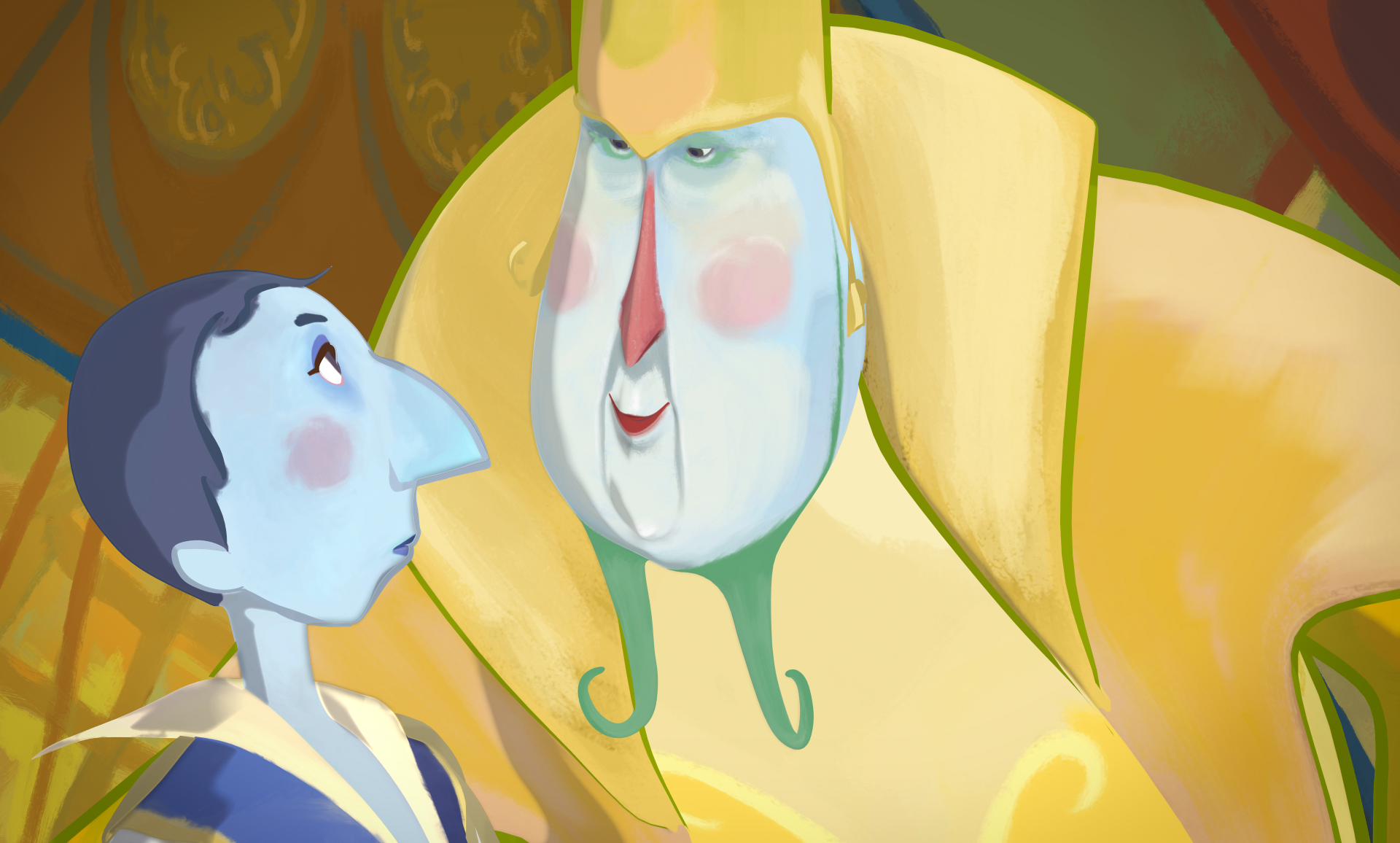
Original language title: Le Tableau
Country: france
Year: 2013
Running time: 76
IMDB: http://www.imdb.com/title/tt1891769/combined
Jason says: “THE PAINTING (LE TABLEAU in the original French) is beautiful, and witty, and smart; you can tell that from the first frame of this movie about the lives of the figures inside a painting. And if it merely maintained that level of cleverness it would be something special. Instead, it kicks things up a notch, giving the audience even bigger ideas to chew on when it could just be tidying up.
“Within one particular painting, there is a rather rigid class system – those who have been completely painted, the ‘Allduns’, live in the castle; the ones who lack some finishing brushstrokes, ‘Halfies’, are shut out and occupy the garden; while both look down on the ‘Sketchies’. Alldun Ramo (voice of Adrien Larmande) and Halfie Claire (voice of Chloe Bertier) are in love but must meet clandestinely, and one of those meetings results in Ramo, Claire’s young friend Lola (voice of Jessica Monceau), and Quill (voice of Thierry Jahn) – a Sketchie with good reason to be resentful – on a boat heading for the edge of the painting, then emerging into the studio with the aim of asking the Painter to finish them.
“As the film starts, it looks like director Jean-François Laguionie and his co-writer Anik Leray are primarily going to be using the painting as a metaphor for race and class, and they get a lot of good material out of that: There’s no mistaking the fascism in the words of Alldun leader Candlestick, and even the younger, more idealistic characters like Ramo and Lola can find themselves unconsciously treating Quill poorly. A pit stop in another painting of armies battling features a pointless war based entirely on whether the soldiers’ uniforms are painted red or green. It’s not always subtle, but it’s well done.
“But once the characters reach the edge of the canvas and reach a studio filled with other paintings but not painter (other than a self-portrait)… Well, that’s when things get clever. The position of the Painter in this society has been familiar – the Allduns claim that he has placed them at the top of the food chain, while the Halfies and Sketchies hope for his return to finish them – but what does one do when confronted with the evidence of the Painter’s caprice, or at the very least absence? Laguionie and Leray offer two answers that, while not serving as a repudiation of the characters’ religion, suggest alternate routes forward, and are able to suggest nuance while still having fun.
“After all, for all that the filmmakers fill their movie with metaphor and ideas, it is still very much a playful picture, with Lola introducing herself to the audience as it starts, a number of art-related gags sprinkled throughout the picture (some not quite surviving the translation to English, such as Quill or ‘Plume’ having a friend named ‘Gum’), and a tendency to solve problems with whimsy and youthful exuberance as much as seriously considered plans. The French-language voice cast, at least, is quite charming, especially Jessica Monceau as Lola and director Laguionie, in a bit of cheek, giving voice to the self-portrait. Note that most theatrical screenings will likely be dubbed in English (only the 9:35pm show is subtitled here in Boston), as the distributor is looking to appear to make it easier for kids to see. Though the film is being released unrated, it’s pretty mild – there’s no harsh language, the one sort of scary bit of violence is not traumatizing, and while one of the characters who shows up later in the movie is a reclining nude, it’s no more sexual than similar pictures in a museum.
“And as befits a film that takes place within a work of art, THE PAINTING is flat-out gorgeous. The style recalls the old masters that managed to convey quite a bit of emotion and personality with just a few carefully chosen brush strokes, with an often- dazzling color palette that resembles bold paint more than perfectly lit and shaded rendering. That said, Laguionie and company don’t go for a flat, hand-painted feel; though the styles are unusual and change from character to character, especially when dealing with Sketchies and those from other paintings, the production is digital enough that characters can turn and move in three dimensions both inside and outside the painting. The studio has its own unique look, an exaggeratedly stiff sort of CGI that contrasts with the painted worlds and seems utterly photorealistic until…
“Well, that would be telling. Suffice it to say that the film ends in a highly satisfying manner, never diminishing the scale or importance of the ideas that made it so clever but refusing to be completely serious or solemn. It’s a thoroughly joyful film, able to spur spirited discussions if one so desires, but beautiful and fun enough to be worthwhile on those merits alone. 5 cats
“Seen 26 May 2013 in Landmark Kendall Square #4 (first-run, DCP).”
Chris says: “For an animated feature, this has an stimulating premise: a sustained peek into the inhabitants of an unfinished painting and how a few of them venture outside the frame to seek their creator in hopes of getting him to finish the work. As visually stunning as one could hope, THE PAINTING unfolds onscreen like a dream, referencing a host of French artists with both reverence and playfulness; unfortunately, I didn’t find the actual story to be so sublime. Dividing the inhabitants into three classes (‘Sketchies’, ‘Halfsies’ and ‘Alldunns’—the original French terms probably sound less hackneyed) propels the narrative and creates necessary conflict, but it’s far too heavy-handed and simplistic, casting a pall over the film’s more effervescent pleasures, like the soothing, rejuvenating nap a character takes within a flower, or the inventiveness of one painting’s inhabitants crossing over to a separate artwork. Overall, it’s like a book with a pretty cover, intermittently marred by lesser content on the inside. 3 cats”
Toni responds: “I personally will stick with that the contents albeit with surreal surroundings have true merit in a limited dialogue way; I think if you dig deeper in walking it you can find a message at a different layer in being very philosophical and profound with some humor sprinkled in at times as well but I guess this film is an acquired taste as is most independent animation for general and independent audiences.”