Jason
says: “Like many documentaries about films and filmmakers,
BOUNDLESS will likely eventually end up as the extra disc in a box set
(in this case of Johnnie To films), which is fine: That would get
it to its audience and it’s not necessarily worth paying for on its
own. It is a decent enough look at where To is now and a fair
attempt at using his career as a surrogate for the last twenty years of
the Hong Kong film industry, although there is probably a better movie
to be made asking those lines.
“Director Ferris Lin Ze-Qiu starts out by showing where To was quite
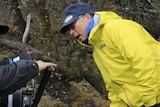
literally at one point, in China’s Yunnan Province shooting ROMANCING
IN THIN AIR, and not having a great time of it: It’s much colder
than the crew from Hong Kong are used to, and that group is augmented
by a bunch of mainlanders who, in To’s eyes, mainly get
underfoot. He even seems a bit cranky when he’s interviewed on
that particular set, and it sets up a potentially interesting way for
the film to proceed – how does a man whose personal and artistic
identity is so tired into Hong Kong specifically handle how the vast
but restrictive People’s Republic of China is pulling at his industry
like a gravitational force?
“It’s an issue Lin and company touch upon, though mostly indirectly –
it’s one thing for a world-renowned director to get frustrated by new
staffing practices; it’s quite another for him to make comments about
language restrictions or censorship that might get a market of a
billion people who seem to really like movies cut off from him (this
goes double for Lin, a film student making this documentary as a thesis
project). So this major influence on Hong Kong and its film
industry is tiptoed around to an unfortunate extent; the most forceful
words on the subject come from critic/scholar Yau Nai Hoi, who says
that a city like Hong Kong losing its distinct voice in film and
culture would make it ‘pathetic’. It’s also note that in 1997, a
year in which To’s fledgling Milkyway Image production company nearly
collapsed, only about 70 films were made in Hong Kong – which sounds
pretty impressive for a small city-state of five million people, but
was well below what it did at its peak.
“Fortunately, enthusiasm for Hong Kong as a unique place let’s Lin
focus on some of To’s best qualities as a person and a filmmaker.
There are moments when the discussion of specific HK events and
locations go on a bit too long without context for those of us who only
know the place through film, but they do eventually lead to a nifty
visual demonstration of how To captures the place’s character both
despite and because of his limitations in filming (he and frequent
collaborators like actors Simon Yam & Lam Suet and stunt
coordinator Yuen Bun talk about filming at night out of necessity) as
Lin contrasts real locations with how they appear in To’s films.
It shows how he both shots a place as it is and reduces it to its
essence, which dovetails with the idea of him placing a premium on
community.
“Other juxtapositions don’t quite work out so well – there’s a point
where discussion about how much of THE MISSION was scripted on the fly
is followed relatively quickly by a clip from EXILED
that is clearly the work of someone who plans every detail. The
way he talks about the ELECTION
movies also suggests that he puts a great deal of thought into his
films, much more than one might expect for genre movies that don’t
visibly subvert the audience’s expectations. There’s also a
plainly but modestly stated thread about how To is constantly looking
to try new things, from the stunt work in LIFELINE to the long take at
the start of BREAKING NEWS to the greater scale of the recent Chinese
co-productions. It makes me wish that remake of LE CERCLE ROUGE
had happened, to see what he’d come up with working in/with Europe.
“Of course, it also makes me want to watch the ELECTION movies again,
this time with the context of an institution with democratic principles
having them diminished firmly in mind. And watch SPARROW again
because it’s so damn beautiful, or THE MISSION and THROW DOWN because
the clips shown look amazing. BOUNDLESS may not be the best
examination of Johnnie To’s life and work, but it certainly makes it
clear that he’s worth one’s attention. 3.5 cats
“Seen 15 June 2014 in the Museum of Fine Arts Remis Auditorium (New
Films from Hong Kong, digital)“ |