
By Chlotrudis Independent Film Society
Rating: 4 cats
Director: Lee Sang-woo
Starring: Jeon Hye-jin | Kim Roe-ha | Moon Sung Keun | Myeong-cheol Shin
Original language title: Jageun yeonmot
Year: 2010
Running time: 86
IMDB: https://www.imdb.com/title/tt1517145/
Jason says: “A LITTLE POND’s goal is to educate its audience about the Nogunri massacre of 1950, and it succeeds: It presents a reconstruction of that shameful incident in the best detail that the filmmakers could extrapolate. It is almost not necessarily to say any more about it; writer/director Lee Sang-woo aims to depict this thing and does so, well enough that he does not squander the horror inherent in the facts.
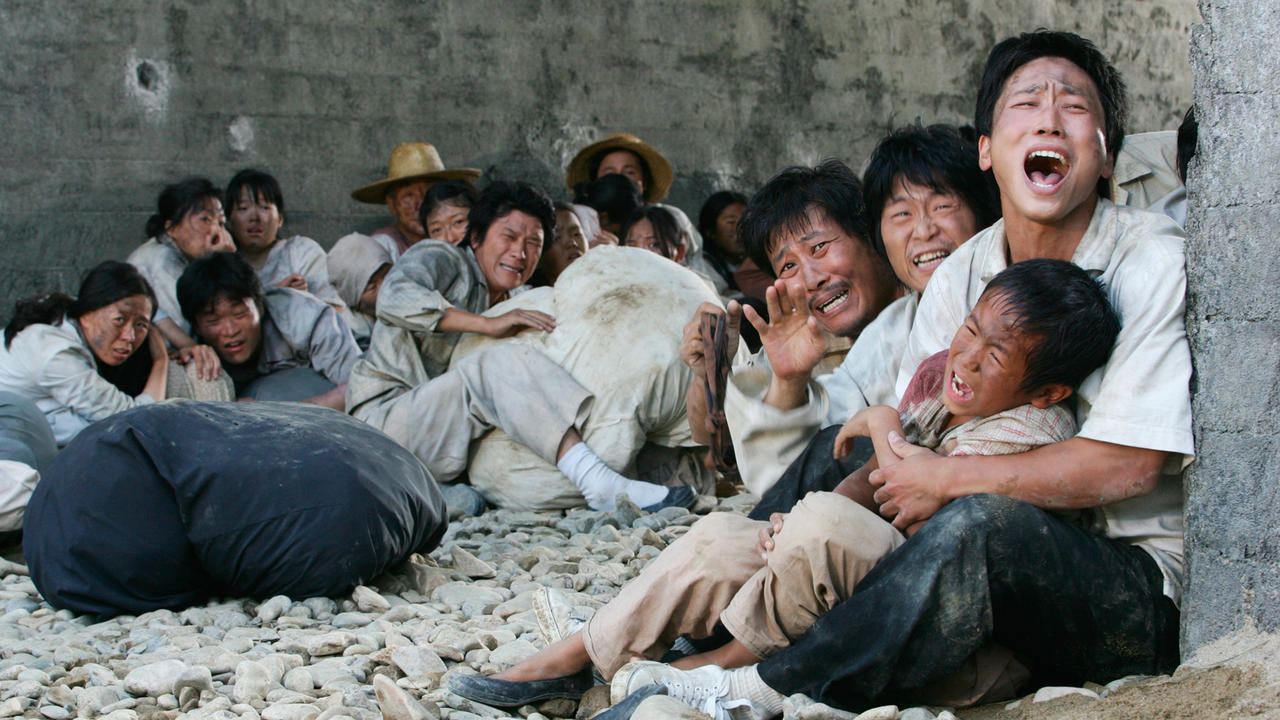
“The movie spends a little time building to its incident. In July of 1950, the Korean War was just starting, and the North was pushing south. A soldier visits the house of Mr. Moon (Moon Seong-geun), though it is not the middle-aged man with the young new wife that they are interested in, but his son-in-law (Lee Dong-kyu), who was originally from the north. Elsewhere, Moon’s second daughter Hyun-i (Kim Ji-hyun) is taking her shift at the village school, supervising the chorus which is practicing for a regional competition. It is a tense atmosphere, but not yet one that is critical. The tension moves up a notch when American and ROK soldiers order the town evacuated, as a battle there is imminent. Many head for a nearby hill, where they had often holed up during the Japanese invasion. However, things change quickly in battle, and the American troops have orders to shoot anyone crossing the front line, which places many of the villagers in the line of fire, taking cover under a bridge, hoping for things to stop.
“The facts in the Nogunri case are disputed; the best-known account was published fifty years after the actual incident, but almost as soon as it led President Clinton to issue an official apology, it was found to be based in part on fraudulent accounts. Everybody agrees that civilian refugees were killed; nobody agrees on the number (cited as anything from 5 to 400) or whether the U.S. Army attempted to cover it up. I would be interested to learn how much research Director Lee did in preparing this film; much of it is told from the perspective of the village’s children, who sixty years later would be the best primary sources.
“As a result, there’s something oddly anonymous about the film. There are vague storylines during the first act, built up just enough that we will have a sense of loss when the shooting starts and it becomes clear that none of the stories about families in a rural village are going to play out. A lot of characters, especially adults, don’t even get names, even in the credits, where they wind up specified as ‘so-and-so’s aunt’. We learn enough just to establish a vague feeling of normality, but not to gain a great deal of insight into these people as individuals.
“When things get ugly, they do get really ugly. Lee shows what happens plainly, with occasional bursts of graphic violence, but it’s not the heads exploding or children being cut down that necessarily make the biggest impressions, but how he shows both the illogic and the inevitability of things. There are scenes of American soldiers stopping Korean civilians on the road that will seem terribly familiar from a number of recent Iraq war films, while other moments show villagers desperately trying to figure out why their American allies are shooting at them, or those GIs shooting at refugees in the distance but calling for a medic to treat the one who happens to be closer to them. It is often the very definition of senseless.
“Which, quite frankly, is probably what Lee Sang-woo is going for. The characters must be a little generic, or it becomes a movie about the guy you identify with (plus some other people). It’s a more visceral experience than reading about Nogunri in a history book, but not necessarily a more intimate one. You’re seeing history, not a story set against the backdrop of history.
“Admittedly, that kind of history lesson is not why most people go to the movies. It’s valuable and I don’t regret seeing this movie at all, but for a narrative feature, it is decidedly slanted toward education and away from entertainment. 4 cats”
“Seen 25 July 2010 in Salle de Seve (Fantasia 2010)”