|
Bruce says: “Award winning video artist Steve
McQueen makes a stunning directorial debut with his evocative film documenting
the conditions leading up to the 1981 hunger strike led by Bobby Sands
at Her Majesty’s Maze prison nine miles from Belfast.
“The film begins, not with Bobby Sands as one might expect, with
the morning ablutions of Ray Lohan (Stuart Graham), one of the prison
guards. He soaks his hands in a water-filled basin, hands that he has
bloodied from abusing prisoners. As he leaves his house he checks for
explosives underneath the car. Next we follow a new arrival at the prison.
He is Davey Gillen (Brian Milligan) and he refuses to wear prison clothes
saying, ‘I will not wear the uniform of a criminal.’ The guard behind
the desk stares him down until he removes his clothes, item by item. He
is tossed a blanket and led to a cell filthy with excrement on the walls.
He has a cellmate, Gerry Campbell (Liam McMahon), a man already demoralized
by the abuse. At visitations wives and girlfriends smuggle in food and
transistor radios.
“Suddenly prisoners’ heads are smashed against walls and bodies
are dragged through the corridors. One prisoner has his hair brutally
cut off with scissors that cut into his face, eye and head as he struggles.
This prisoner is Bobby Sands. ‘Are you all right, Bobby?’ his mother asks
at the next visitation. His head covered with bruises and open wounds,
Bobby replies, ‘I’m grand, Ma.’
“Mc Queen’s video background, noted for his unique perspectives,
is put to good use as he examines the environment his characters inhabit.
He films the prison riots and the brutal retaliation by the prison guards
as a video ballet, overlapping images in extraordinary pastiche. But McQueen
does not shy away from conventional filmmaking techniques. In one beautiful
twenty two and a half minute scene, he uses a stationary camera placed
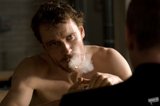
at eavesdropping length from Bobby Sands (Michael Fassbender) and Father
Moran (Liam Cunningham), his friend and priest. The longer the camera
remains fixed the more the viewer’s eyes and ears strain to devour
the articulate content of the conversation. Diametrically opposed, the
two men express their positions on hunger strike as a viable political
technique. When Bobby’s conversation moves from the philosophical
to a personal example from his boyhood that eloquently illustrates his
principles, a close-up is used. The scene is one of the most memorable
in recent history and made more so by the scene that follows. Once again
a stationary camera is employed, positioned at the end of an empty cellblock
corridor. One of the guards pours disinfectant of the top of the urine
that has flowed into the corridor from the individual cells. He then slowly
mops the floor pushing the mixture of detergent and urine towards the
camera with an occasional slosh to the side, deliberately pushing the
mixture into a cell or two that house inmates he presumably dislikes.
“So the hunger strike begins. Bobby’s decline is carefully
documented and is difficult to watch. He wastes away. His body develops
open sores which a loving orderly delicately dresses. He coughs up blood
and vomits. He has convulsions and delirium as his bodily functions shut
down. HUNGER illustrates how incarceration and confinement foster sub-human
behavior on both sides. 5 cats
“HUNGER screened at the 2008 New York Film Festival.”
|