a report by Chlotrudis member Cheryl Eagan-Donovan
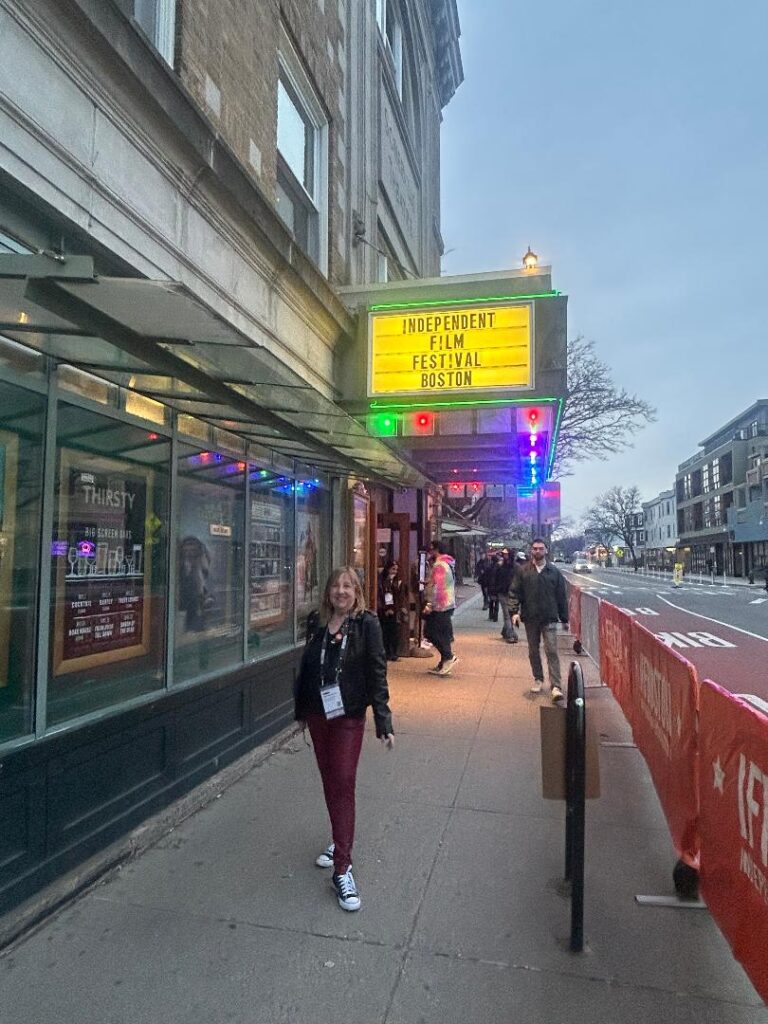
The 23rd Annual Independent Film Festival Boston, which ran from April 22nd through the 29th this year, was a bit of a wild ride. I missed the opening night film because of a prior commitment, but all reports from my Chlotrudis peers and others in attendance were that Boots Riley showed up in his usual extravagant style and entertained the capacity crowd for the Boston premiere of his latest film I Love Boosters. I hated to miss it again – we missed it as the opening night film at SXSW too – because I love Keke Palmer and I also really enjoyed Riley’s surrealist comedy Sorry to Bother You. His new film got mixed reviews from friends who don’t love his unique mash-up of camp, political satire, and absurdist humor, but it seems to have set the tone for the rest of the fest by refusing to take itself too seriously. Since its May 22nd theatrical opening, it’s holding steady at 92% on Rotten Tomatoes.
The first film I saw was the documentary First They Came for My College which had also played SXSW but premiered at the True/False Film Fest. Not just thought-provoking but genuinely disturbing, the story of a hostile right-wing takeover of a small, truly liberal liberal arts college ends on a hopeful note, with students fighting to maintain their “everyone is welcome here” esprit de corps and persevering in the struggle against a stacked board, book bannings, and faculty firings. Perhaps because I have been teaching at a small university for the past fifteen years, this film really struck a chord with me. I am still free to teach Sappho and Plato in my long-running Freshman English Writing course “Gender, Identity, and Sexuality in Literature, Theater, and Film”, but the Humanities department has been significantly reduced by the corporate mission of the university administration. In many ways, New College of Florida reminded me of the now defunct Goddard College in Vermont where I wrote poetry as an undergraduate before transferring to Boston University to study business and finance. The students at New College have a gardening club where members jump in the bay after weeding and planting, they have “Feminist Fridays”, annual screenings of the Rocky Horror Picture Show, and an informal policy that says you can wear whatever you want to graduation. Those students who stayed at the school even after the Desantis appointment of six ultra-conservatives to the board of trustees, including hate-mongers Christoher Rufo and Matthew Spalding, were cautiously optimistic about the future.
There was an excellent post-screening Q&A, with director Patrick Xavier Bresnan, producer Harry W. Hanberry, former New College professor Amy Reid, and three former students who appear in the film. They shared their memories along with their current work as activists. Reid now works for Pen America and noted that twenty-three states have passed at least one higher education censorship law in the past five years. Film critic Gerry Peary pointed out that one of the most interesting subjects of the film was a conservative student named Josh who came to study law. When asked what happened to him, the students on the panel revealed that after working on a classmate’s thesis film, he had changed his career track to filmmaker. The documentary project began when a film student started shooting what was happening on campus, and Hanberry, a New College alum, launched a crowdfunding campaign. They raised $230,000, asked another student to start filming with her iPhone, and then hired Bresnan to direct. Asked about the title of the film, Reid said, “This is a fight against fascism”, explaining that the community chose it. “College is the closest you can get to utopia” one of the panelists quipped, and the students at New College are committed to preserving that experience and to “making a better world”.
The next film on my schedule was the new feature by Greg Araki, I Want Your Sex. With this film, Araki crossovers over to mainstream markets, like Pedro Almodovar and John Waters before him, who began their careers with truly punk rock projects not unlike Araki’s The Living End. Olivia Wilde kills in a role that showcases her versatility and strength as an actor in this genuinely laugh-out-loud satiric look at the intersection of work, power, and sex in the age of Instagram. The film premiered at Sundance and features Cooper Hoffman as the sycophantic assistant to Wilde’s dominatrix and art world phenom, who quickly realizes he’s in over his head. Hoffman as the sub/boytoy brilliantly embodies today’s thirty-something man looking for the meaning of life. Together they are hilarious. The film sold to Magnolia Pictures for a reported seven figures and takes Araki’s singular sensibility to a whole new level. A triumph for the auteur who knows how to take us on an outrageous and unpredictable trip.
On Saturday afternoon I did some networking at the LEF Foundation Annual Filmmaker Reception, this year co-hosted by the Documentary Producers Alliance, at the Crytal Ballroom. I talked with friends and colleagues about the 20th anniversary of my first documentary All Kindsa Girls and my new film All the World’s a Stage.
Saturday night I attended the Boston premiere of The Great Experiment, the latest film from director Steve Maing, who worked on my previous two films, All Kindsa Girls and Nothing Is Truer than Truth. Steve edited the 2026 Academy Award winner All the Empty Rooms and has been building his filmography with increasingly thought-provoking cinematic works, from High Tech, Low Life (2013), and Crime + Punishment (2018) to the Oscar-shortlisted Union (2024). This new film represents another major break-through for a new American filmmaker. The Great Experiment documents life across the United States over a period over four years, from 2017 and the first Trump administration, through 2021, on the brink of the COVID pandemic. Gorgeously shot in long, slow, black and white sequences, it is both meditative and truly thought-provoking: a study in citizenship, polarization, and identity. Some of the most striking visual moments in the film, captured in stark verité shots, include live footage of the January 6th attack on the Capitol, the sacred blessing of the guns at an event hosted by the son of Reverand Moon, a casual conversation with Nestor, a young man who identifies as a member of “Gays for Trump”, and scenes of immigrant families.
The film is bookended by a giant gate at the border being shut by ICE officers as the opening, and a cohort of individuals receiving their American citizenship, ending with the words spoken by the presiding judge: “welcome and thank you”. It is an extremely powerful and emotional film, demonstrated by the vocal engagement of the audience throughout the screening and their poignant comments during the Q&A. Steve said he set out to “widen the frame to create an impossible composition of contradictory feelings”, to encompass all the diversity and complexities of this country in the twenty-first century. He tries to remain objective and neutral in the portraits he reveals, but by asking “how do we sit with this discomfort?” he tips his hand a bit. The Great Experiment compels us to think about who we are. The responses from the audience were visceral. One viewer praised the soundscape, the use of music, and the nonverbal expressiveness of the film, noting the haunting effect of the experimental vocalizations by Meredith Monk, at times seeming to imitate Native American chants. She then added that she really loved the film, even though she is blind. Steve graciously acknowledged the support of his long-time friend Anne Marie Stein as producer, and the partnership with his co-director Eric Daniel Metzgar, but also thanked his family, producer Trina Rodriguez and his daughter, Rosie. An audience member said, “I think this film is your masterpiece” to which the filmmaker quickly replied, “Can you repeat that on camera?” This film does indeed have heart, and legs, and may well become his legacy. But we are looking forward to seeing what he does next!
Sunday afternoon I went with two young filmmakers to the Open Screen event. This was the first time IFFBoston had featured this opportunity for an open-mic style program, where anyone can submit their video or film with a total running time of ten minute or less. They will even screen your work on DVD. Since 2003, Boston Open Screen has been presenting random works by local makers ranging from promising debut short films to truly amateur media projects. They currently screen monthly at the Coolidge Corner Theatre, an IFFB venue, but the festival event took place in the microcinema screening room at the Somerville Theatre. The hosts do not prescreen the submissions but do round out the program with a few selections of their own. The mix on Sunday included a few standouts: a short film obsessing over Timothy Chalemet’s hair, a very clever deconstruction of the evolution of his various coiffures as they paralleled his career, using all archival footage, and Chick Money, a wicked satire about a working girl’s wild fantasies, beautifully shot, edited, and acted. But full disclosure: I’m completely biased. My social media manager for my new film, Hannah Doyon (AFTERS, 2025), wrote, directed and stars in this proof-of-concept for a TV series set in New York City, and my post-production assistant and son Liam Donovan edited the short. The other films in the program were often bizarre if not totally inscrutable, but overall, it was a very fun experience.
On Monday I went to the Brattle Theatre in Harvard Square to see Filipinana, another Chlotrudis sponsored film (we also sponsored I Want Your Sex, Blue Heron, and Romeria). This Sundance Special Jury Award-winner, directed by first-time filmmaker Rafael Manuel, worked as a surreal mix between a White Lotus episode and the cult favorite 1960s TV series The Prisoner. Set at posh golf resort in Manila, the film is shot with eerie, slow, cinematic takes, used to build tension, juxtapositioned with moments of humor that belie the sinister undercurrent. The protagonist Isabel, played by Jorrybell Agoto, is a new tee girl, curious and courageous enough to seek out the hidden truths and secrets of the club and its president. Agoto’s performance is wonderfully emotive, expressive, stoic, and mysterious. When she finally finds the golf club president at the climax of the film, she must make a choice that will determine her future – and this moment is followed by the revelation we’ve been waiting for, hinted at by clues in the minimal dialogue at the end of the film: the repetition of “no one will find out” and “you do know he’s harmless…”. The ending is equally enigmatic: does she disappear and escape or become stuck in the weeds and drown? A brilliant debut film.
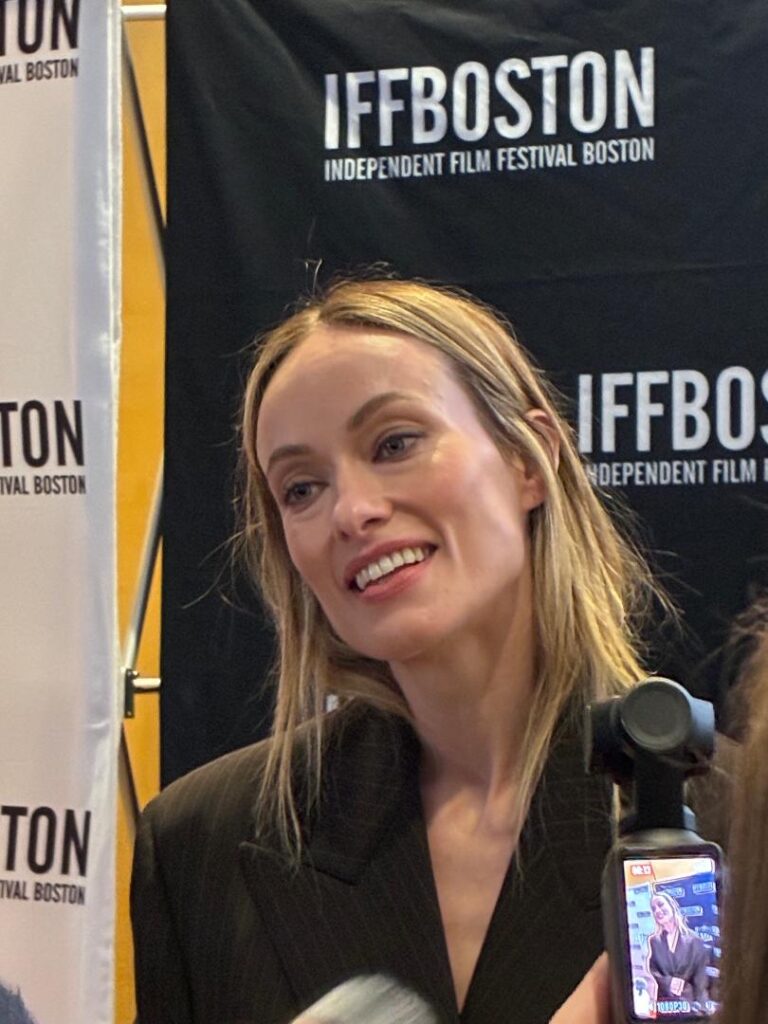
The closing night film at the Coolidge Corner Theatre was Wilde’s third feature film as director, following on her previous efforts Don’t Worry Darling (2022) and Booksmart (2019). The Invite benefits from an A-list cast: Ed Norton and Penelope Cruz as the upstairs neighbors, and Seth Rogan and Wilde as the couple looking to recapture their long-lost bliss. Clearly riffing on Edward Albee’s tour de force Who’s Afraid of Virginia Woolf? the comedic premise works well – until it doesn’t. The set up is flawless. Wilde’s character invites the upstairs couple to dinner, unbeknownst to her husband, and when the neighbors start talking about their extremely audible sex life, hilarity ensues. Soon they are trading partners before going full-on four way, but when the script shifts to a heartfelt reconciliation between the Wilde and Rogan at the open-ended, meant to be thought-provoking, conclusion of the film, the tone is deflating.
“Will they stay together or split up?” Wilde asked the audience during the Q&A, and they were pretty evenly split on the predicted outcome. But the entire tone of the post screening discussion, featuring Wilde’s favorite couples’ therapist, was too serious and frankly, depressing. It totally killed the vibe and went on way too long. One friend and film aficionado told me the film failed for him when the orgy sequence started. He felt it was completely unrealistic and found it impossible to suspend disbelief. Although the entire film was “over-the-top” to the same extent as Araki’s I Want Your Sex, Wilde’s vision could not match Araki’s cumulative cinematic experience and indie cred. The sudden tonal shift at the end – the melancholy piano duet that bookends the film – defused the energy and made the high jinks seem even more forced. Sweet and funny or biting satire and edgy? You decide: choose your own adventure.
The closing night party was subdued, at least immediately following the film when I arrived. Programmer Nancy Campbell was holding court at a corner table, and only a few filmmakers were taking advantage of the movie-themed charcuterie – including the “jamon” as Wilde calls the prosciutto to Cruz’s amusement in one scene – but there were no complimentary drinks. It had a different feel than previous years closing night parties, held at local restaurants or bars in the neighborhood. It’s great that the new Coolidge wing has the space for private events but the other festival parties at the Crystal Ballroom were definitely more “festive”.
All in all, this year’s Independent Film Festival Boston appears to have been a success in terms of turnout, and as always, Nancy Campbell and Brian Tamm did a great job curating the best of other fests along with a few local gems. My favorites were Araki’s latest subversive satire – too funny – and Maing’s “masterpiece”. Great cinema transports us to “undiscovered countries” even when they are in our own backyards or bedrooms. Thanks for the ride IFFB!