By Chlotrudis Independent Film Society
Rating: 3.5 cats
Director: Adam Kahlil | Zack Kahlil
Year: 2026
Running time: 82
IMDB: https://www.imdb.com/title/tt39150051
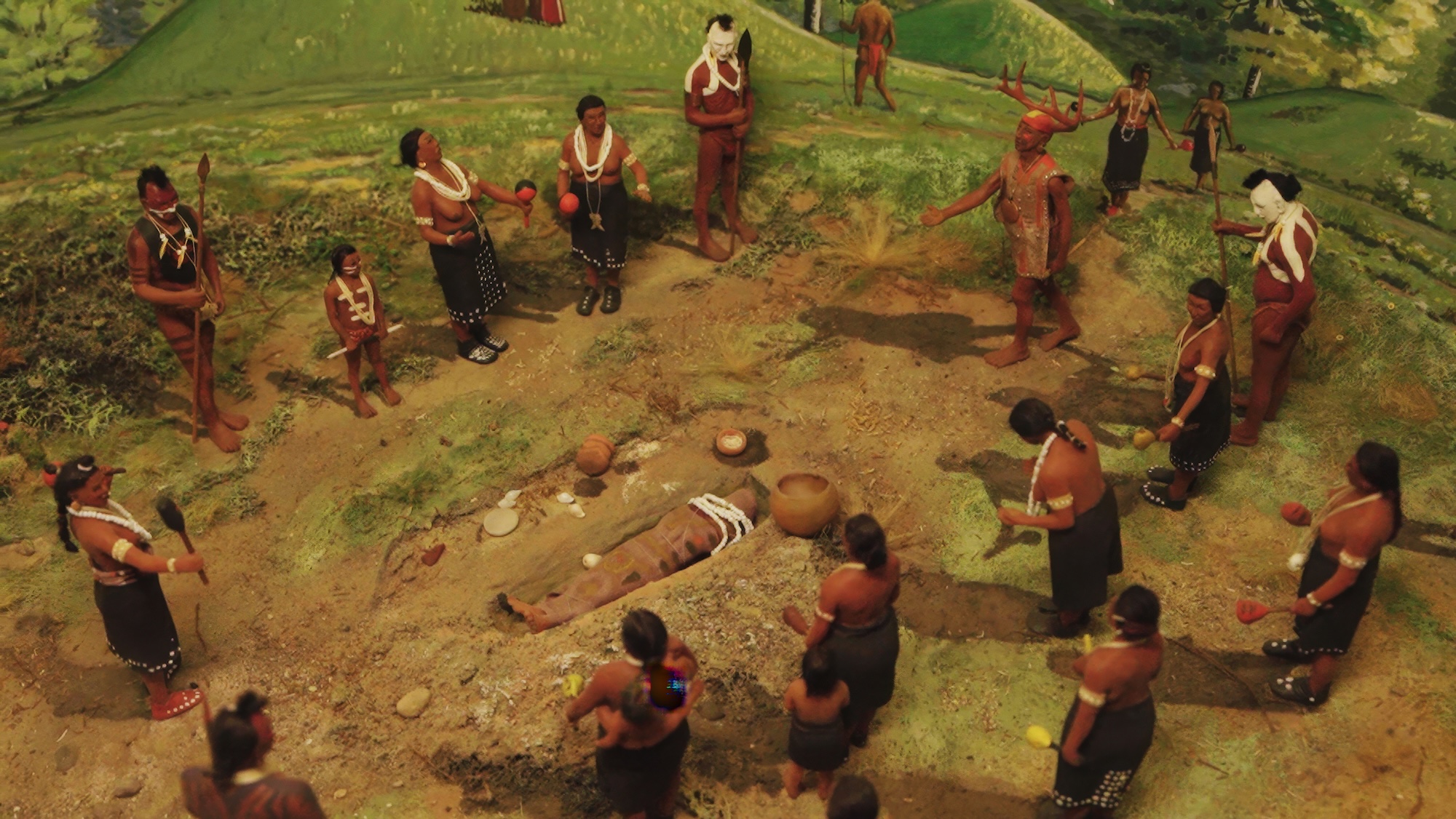
Cassian says: “The Khalil brothers take us through a deeply emotional decades-long journey of reburying the remains of their ancestors through the process of indigenous repatriation. This documentary follows MACPRA (Michigan Anishinaabek Cultural Preservation and Repatriation Alliance), a unified group representing the indigenous tribes of Michigan, as they work to reclaim the remains of their ancestors. After 30+ years of the Native American Graves Protection and Repatriation Act or NAGPRA, American universities and museums continue to hold onto almost half of the ancestors, about 210,000 human remains. You can read more about it here.
“The use of experimental visuals, music and sonic effects/sequences worked very well to deepen our understanding of Native American culture and it built up to some very profound and beautiful moments. 4 cats.”
Brett says: “The title AANIKOOBIJIGAN carries the entire theme of this documentary in just that one word. It is a fundamental that one’s being is at the same time that of a grandparent, the grandchild of that grandparent, and also an ancestor perhaps long departed, meaning that many people’s concepts of past, present, and future are actually linked and fluid instead of being divisions of time.
“In terms of a music record, one would not say the record is over after track one and a new album begins once that first song ends. Even deeper, a single song is not complete after the first cycle of verse-chorus, and consider the fact that several songs make up the full album. Similarly, on a record, one rotation doesn’t signify completion of the full album. But, even using something finite like an album/record and the term ‘full’ are not the best analogies because Earth is in the middle of an ‘album that doesn’t end,’ Lambchop. Perhaps the record metaphor does work somewhat in that it is not something that is tossed away after the many fixtures that comprise it have completed a cycle. It is replayable, it is still revered after the fact–present with us even when it’s not actively in ‘play’ mode–and it is still always part of a bigger library or catalog.
“The above digression and inspiration from this film aside, the documentary is a look into the collection of human remains via museums, libraries, and archives under the guise of science and how those people are ancestors with homes. When breath leaves a human being, does the human being cease altogether? Not so in the eyes of MACPRA (Michigan Anishnaabbek Cultural Preservation and Repatriation Alliance).
“The film explores a repatriation movement which indigenous groups in the U.S. have been organizing in order to return those bodies to their rightful places among the earth. Existence is viewed as a spiral with loops of the spiral adjacent to each other, so as someone else might look back in a linear sense at someone who has passed, the argument here is that those whose breaths have stopped are still near us and with us because of how spirals function, as opposed to a line that distances itself from a previous point on the line the further it progresses. This spiral is the aforementioned “never-ending” record. Would it be condoned for someone to go to a grave site the day after a funeral and exhume the body? While the answer to that may be obvious, the spiral nature of human existence through the eyes of indigenous peoples represented by MACPRA is one that presents a circumstance along those same lines.
“The term repatriation is the legal terminology and one that is a matter of ‘property.’ The word choice adds to the morality in question here. In line with the terminology of property, one might associate land with the word property, which is also a matter that’s part of the conflict here since native lands have been claimed by colonization, in line with the dismissiveness of claiming the remains of those who inhabited those lands as if property. ‘Rematriation’ has a mother-like connotation, as in Mother Earth–if you will–and it humanizes the efforts to reconnect ancestors with the earth.
“Also ironic in groups like MACPRA who have to adopt the term repatriation to combat the perceived wrongs being perpetrated, the group itself can only function and fight to achieve its goals by becoming a bureaucracy of paperwork, legality, and steps, thereby having to become that very thing which it is fighting against.
“There is a common adage that ‘knowledge is power,’ but a very powerful platitude accompanying this particular subject is that ‘knowledge is place-based.’ That is, the accumulation of what is agreed-upon knowledge is compiled by those in that particular area. So, the common knowledge of one group that ancestors of the earth belong to the earth is featured in a battle with another set of shared common knowledge that is an ongoing legal struggle to this day.
“The documentary is a great subject and proves insightful and a very good discussion piece. Some may find that the efforts to be inclusionary and educate the general public may be repetitive in a few places, but the heart and sincerity is in the right place.
“3 CATS OUT OF 5”
Eliza says: “Viewing from a place of privilege, I hadn’t really heard of repatriation before. It seems so absurd to me that Indigenous remains were dug up in the first place, and I’m one among many who think ‘why weren’t they just left there, undisturbed?’ The desecration of thousands of gravesites is not a small slight of misconduct. Yet, in the name of science and archaeology, it was accepted because our patriarchal society wanted the bones. Why did they want them? Often times, to try and find “reasons” in which to echo-chamber the idea that Caucasian humans were more intellectually valuable than other races. And where they wanted to find evidence, they’d manufacture it in drawings and diagrams that fellow white people took to believing.
“One of the saddest parts of the film in my opinion was the talk of The World’s Fair. As a child, I looked to the world’s fair as being a joyous celebration where lots of nationalities came together to celebrate life and shared humanity. To hear that part of the motivation for the world’s fair to happen was to have Indigenous people travel and work the fairs, in hopes they would contract polio.. was devastating. Not because it crushed my childhood musings, but because it’s downright cruel. It baffles me. The local ‘scientists’ would lay in wait for them to die, and they’d seek claim over their remains.. for ‘science.’ This level of planning seems like a calculated wish for the death of non-white communities, because entitlement reached further than any humanity we are supposed to share. Which leaves me to ask, once again, “Why couldn’t we just leave them alone?”
“With talk of time being a spiral, where past, present, and future are all aligned and adjacent.. the sacred act of being one with the land whether above it or under it, is one that thousands were robbed of. Museums and research centers housing thousands of boxes of remains (made of the same cells we are all made of) sitting on metal slabs in sterile rooms. The opposite of organic.
“The film spoke of Indigenous people living in harmony together and everyone being equal and free in their society before colonization. *That* was organic. The film also touches on white guilt, and the discomfort most white people face around that. It feels difficult for me as a white person to even write this review, because I don’t want to amplify another white voice (my own). As someone who hopes to continually grow as a person, this look into the wrongs thrust upon Indigenous people was eye-opening, and something that will stick with me.
“I am so glad this film is raising awareness for repatriation efforts, and I’m so glad many remains have been returned to their organic home.. Mother Earth.
“3.5/5 cats.”