
By Chlotrudis Independent Film Society
Rating: 4 cats
Director: Peng San-yuan
Original language title: Shi Gu
Country: china
Year: 2015
Running time: 108
IMDB: http://www.imdb.com/title/tt2474024/combined
Jason says: “There is an unabashed simplicity to LOST AND LOVE that might often be called deceptive by those who might want to praise the film, especially if its early stumbling didn’t quite click with those viewers. That may not be the case; it’s quite possible that this movie about a man who has long strove to be reunited with his abducted son is just what it appears to be, and works because the emotions involved are easy to grasp.
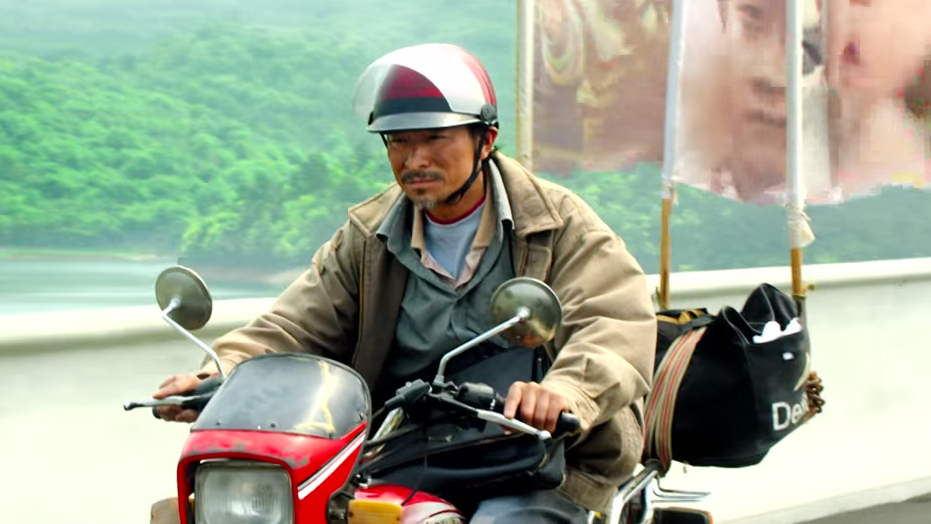
“Two missing children are introduced at the start: Zhou Tianyi, an infant who was just taken recently, and Lei Da, who disappeared fifteen years ago, when he was about a year and a half old. Tianyi’s mother Su Quin (Ni Jing-yang) is practically hysterical as she stands at the spot where she last saw her daughter, but Da’s father Lei Zekuan (Andy Lau Tak-wah) is grimly determined – he’s spent much of the past fifteen years crisscrossing China on a motorcycle, trailing a banner with a picture of his son taken in 1999. Spotting a poster for Tianyi, he adds another banner to the back of his motorcycle. When he crashes, young mechanic Zeng Shuai (Jing Bo-ran) repairs the machine, and reveals that he has a child abduction story of his own to tell.
“It’s hard to imagine this turning into an optimistic film without some very unlikely turns off the plot, and to his credit, writer/director Peng San-yuan never losses sight of how even a happy ending to one of these tales will likely be gut-wrenching for some of the good people involved. He sets the tone right from the start when he first shows a worn-down Zekuan handing out flyers on a ferry; one bystander makes the reasonable observation that this quest has likely reached the point of futility and another immediately starts shouting him down. As much as the film may frame itself as a lonely quest, it also acknowledges a pervasive generosity of spirit, from Zekuan’s willingness to add others’ searches to his own to the network of people around the country willing to help despite their lack of the same personal stake.
“At its core, of course, it’s the story of a father looking for a son and a young man looking for a father. Peng makes it clear early on that Zekuan’s and Shuai’s timeliness don’t quite align in a way that would make a ‘perfect’ ending possible, but there is certainly some pleasure in seeing them fill each other’s needs. Circumstances have Shuai on more solid ground than Zekuan in some ways, and Jing Bo-ran does a fine job of conveying both that and how uncertainty eats away at a person in his situation. He may be the one more likely to initiate the film’s lighter bits – he’s a charismatic young guy – but he also gets to demonstrate the greatest upheaval in some scenes.
“Andy Lau is the man at the center of the film, and while there are times when he seems to be struggling to find the right frame of mind for Zekuan – he occasionally seems to over-emote soon after impressing with stoicism – it eventually comes together as a man who has grown unsure how to handle the world. He subsists on hope but isn’t quite able to process it. This role is also a relatively rare time for him to show his full age on-screen, really projecting someone who is worn out and tired until Zekuan meets Shuai, letting his weariness show when silent and adding weight to his words when he relates a story.
“Interestingly, one of the times he does this actually parallels an incident that happened to him earlier in the film, which does a nice job of calling back without making the earlier scene two much a lesson-learning. That earlier scene is interesting for its setting – a series of floating fishing platforms that leave the footing unstable under Zekuan’s feet – and the series of locations Zekuan and Suhai visit (beautifully shot by Mark Lee Ping-bin) are both evocative individually while also reinforcing just how vast and varied China is. Finding a child in there is looking for a needle in a haystack.
“Toward the end, Zekuan encounters a group of Buddhist monks, and there is something of them to him – a stoic man on an endless quest that has value in the striving as much as the accomplishment. It’s an attitude that serves the film well, making a solid film out of something that could have been oversentimental melodrama. 4 cats
“Seen 20 March 2015 in AMC Boston Common #15 (first-run, DCP)”