by Cheryl Eagan-Donovan
This year my attendance at the Provincetown International Film Festival (PIFF) was abbreviated by other travel commitments, but I still managed to see 8 feature-length films, 2 shorts programs, and attend 5 parties! I hated to miss the awards programs on Saturday, the PFS “Footloose” themed fundraising prom, and John Water’s 2025 pick Pink Narcissus, but London was calling me.
I arrived on Wednesday afternoon via the ferry on a warm, sunny day. Fellow Chlotrudis member and Controversy Films producer Vicki Oleskey and I were staying in the far East End of town and soon became fast friends with Martin the pedicab driver. We had a quick dinner at John Dough’s where we were joined by Chlotrudis Board President Michael Colford. This turned out to be a bad choice because although it was a convenient location next to the Town Hall, the venue for the opening night film, before the credits rolled Vicki realized she had contracted food poisoning. We all had seafood, but it seems that only the lobster was suspect, and unfortunately, the restaurant was not at all accommodating when we returned to complain after the film. As a result, I will think twice before eating there again.
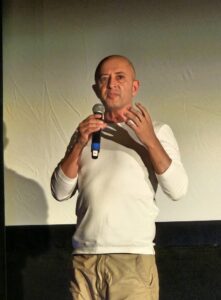
Strange Journey: The Rocky Horror Picture Show Story had played at SXSW in March, and I had heard good reviews. Director Linus O’Brien, son of Richard O’Brien who created the London stage production and its film adaptation as well as playing cast member “Riff Raff”, introduced the film and did a Q&A after the screening. The documentary provides an in-depth look at the origins and history of the Rocky Horror phenomenon. Most people are familiar with the midnight screenings that developed a cult following in the U.S., but I was not aware of the fact that it started as a live stage show in London in 1973. From Kings Road to the West End, it became a huge hit but failed to impress American theater critics and audiences when it ventured overseas to LA in 1974 and Broadway in 1975. Even the film version, also released in 1975, bombed, which led to the late-night screening strategy. And the rest is history.
Director O’Brien (left) deftly blends archival footage, interviews with fan club members and shadow casts: those who play the roles of the characters in costume during screenings complete with props, and scenes talking with his dad about his career as a musician. Richard is an engaging storyteller and talented songwriter and his relationship with the filmmaker lends the documentary a poignant intimacy. In the Q&A, Linus explained that the first time he saw the show it was on Kings Road when he was 4 years old. He explained that fundraising was difficult; they raised money shoot by shoot and were still mixing the final cut 5 days before their SXSW premiere. The longest running film in American history at 50 years to date, The Rocky Horror Picture Show achieved this success by celebrating transgressive concepts of gender and sexuality, the power of music, and the kitsch appeal of b-movies. The interviews with star Tim Curry who made the role of Dr. Frank-N-Furter iconic were a little sad to watch with him now confined to a wheelchair, but his character lives on every weekend in cities around the country. The documentary is dedicated to Sal Piro, president of the Rocky Horror fan club, who passed away in 2023. When asked if his father was reluctant about making the film, Linus explained that although he was a bit uncertain at first, he ultimately agreed because as he says in the film’s closing line, “It’s not mine anymore, it’s the fans’ film.”
After the Q&A, we stopped in at the Opening Night Party at The Crown & Anchor poolside but did not stay late.
Thursday was another beautiful day. Vicki met a friend for breakfast at Yo Lo Quiero, I walked up to Joe’s for an iced Americano, and we met at the Town Hall for the first screening of the day, Sally, a NatGeo doc about the first female American astronaut to join NASA’s team in space. Director Cristina Constantini focuses on the Sally Ride’s struggle to keep her relationships with other women out of the public eye and hold her own in what was then a very male-dominated world. She married another male astronaut to keep up the façade, but her time away from home to be with her long-time lover Tam O’Shaughnessy eventually led to their divorce. The story is told primarily from Tam’s point of view, with lots of terrific archival footage. It’s a fascinating profile of Ride, who was also an accomplished tennis player, and like so many successful, talented people, had difficulty finding time for the people she loved, including her own family. The reenactments were too melodramatic for my taste and not necessary to the story, making the film drag even at just 103 minutes. The Challenger explosion in 1986, in which Ride’s rival and fellow astronaut Judy Resnick was killed, set Sally on a new mission to speak out on safety. She was diagnosed with pancreatic cancer in 2011 and died at her La Jolla home in 2012. In her obituary, her relationship was publicly revealed after 27 years, and the film ends with her life partner O’Shauhgnessy accepting the Presidential Medal of Freedom on her behalf from President Obama.
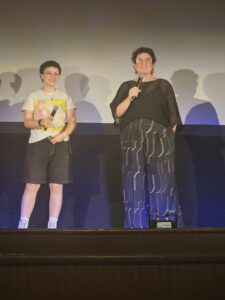
I had a quick lunch at Gabriel’s guest house, where I talked with a few filmmakers before heading back to the town hall. Next up was the narrative feature Jimpa, directed by Sophie Hyde, whose last film Good Luck to You, Leo Grande was a hit with PIFF audiences in 2022. As she did in that film, Hyde again demonstrates her ability to get authentic and powerful performances out of A-list actors and newcomers alike. In a beautifully shot modern family drama, Olivia Coleman navigates between the roles of mother and daughter and negotiates with her loud and fiercely proud gay dad, played with finesse by John Lithgow and her nonbinary teenage child, Hyde’s daughter Aud Mason, who join forces despite their extremely polar generational attitudes about sex and gender. During the Q&A, Hyde explained that the title came from name Aud coined for their grandfather, and that while not entirely autobiographical, the film was inspired by the director’s 75-year-old father, who she described as a very “out, gay, difficult man”. Co-writer Matt Cormack knew that the film required a young, queer person for the role, and Aud brought an emotional truth to the character. Asked how she prepared for the part, Aud quipped “my whole life” and then explained that the on-screen character Frances is a very different person. Audience members remarked on the effectiveness of the flashbacks to portray Jimpa’s experiences as young gay man living through the AIDS crisis, a defining moment for his identity as an activist. They were in fact expertly wrought, seamlessly woven into the narrative. With a less experienced director and crew, these moments from the past could have derailed the story but here they are cinematic memories, vivid but fleeting. Another viewer asked about the scene in which Coleman and Mason Hyde share a bathtub, and Sophie explained that her intent was to portray the intimacy between parent and child that is often lost in adolescence, emphasizing that naked bodies do not always have to be sexualized, and how important that is especially for young trans people. Hyde has emerged as a unique voice rivaling the master, Mike Leigh. I introduced myself to the director and Aud and then wrote a note of support and encouragement to a young person in Australia as part of the film’s outreach strategy.
This year’s documentary slate was particularly strong, and the next feature Everything Moves was another winner. This portrait of the artist Sal Del Deo, a major figure in the Provincetown scene, brought out all the locals and everyone else who loves the town. The film mixes Arthur Cohen’s gorgeous 8mm footage of the dunes, the painter at work, and the history of Commercial Street and its artist colony with interviews with friends, family, and the larger-than-life character Sal. It charts his relationship with the love of his life Josephine, who was the driving force behind the creation of the National Seashore preservation act and the career of her husband. When they opened an Italian restaurant in the West End, they generously welcomed other artists and writers to eat regardless of what they could pay. The new owner Siobhan Carew continues the tradition of pay when you can and has somehow preserved the spirit of the original owner. All the paintings in the restaurant are Del Deo’s. The film also documents the artist’s battle to stay in the dune shack he and Josephine had lived and worked in for years. The townspeople supported him and in 2023 the then 95-year-old artist prevailed. Sal still paints every day, looked in on by his son, and was in attendance at the screening. Cape Cod director Michael Cestaro talked about meeting Sal during the Q&A. He said he fell in love with him and knew there was a story to be told. When asked to join the director on stage, Sal said, “thank you for letting me see my life in retrospective”. I told the director the film should air on the PBS series “American Masters”. It’s that good.
I made the mistake of exchanging my ticket for the last film on my schedule for Thursday, Heightened Scrutiny, a documentary about Chase Strangio, ACLU attorney and LGBTQ+ rights advocate, for Plainclothes which was getting a lot of buzz. The audience loved it, voting for it as Best Narrative Feature. I found it disappointing, with a script that was contrived and full of trite, on-the-nose dialogue. First time director Carmen Emmi delivered a story built on cliches from the premise, an undercover cop entrapping gay men in a public restroom falls in love with one of his victims, to the protagonist’s stereotypical Italian family and the reveal that the love interest just happens to be a married clergyman. The ending is over-the-top, and my thought was that perhaps it was based on the filmmaker’s own experience and inability to effectively adapt the concept to make it work on screen. But I later met another filmmaker who had asked the director if the film was based on a true story, and apparently it was not. We then agreed that the only explanation for the praise for Plainclothes – it also won the Special Jury Award for Ensemble Cast at Sundance – was the strength of its cast. Lead actor Tom Blythe is undeniably hot and both he and Russell Tovey as the object of his obsession do their best with an amateur screenplay.
Thursday night’s party was at The Underground where I had a chance to talk more with Karen Lawler, co-director of the short Beach-O. We had met earlier at a sparsely attended afternoon filmmaker event at the Crown and Anchor, and I was really intrigued by her film and the story of its journey to PIFF. She lives on Long Island and was attending the festival with her husband and 5-year-old daughter, who said upon arrival that she prefers Fire Island!
Friday morning, I opted to go to the New England Shorts Program to see Beach-O. It was very fun! The bands playing on the beach, the 60s costumes, and the b-movie premise are all perfectly executed. The film was shot in Gloucester and on Cape Cod, then paused during COVID after a work-in progress screening at the Coolidge. A must see! Other standouts in this shorts program included Songs from the Mainland about a deaf community on Martha’s Vineyard from local director Michael Cestaro, and 404, an experimental meditation on the current administration’s censorship of language by multimedia artist Gina Kamentsky.
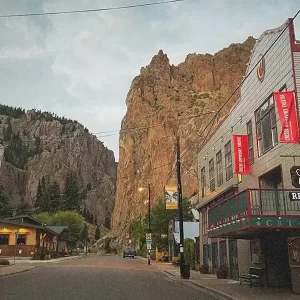
After a quick lunch at Gabriels, I went to see the documentary Creede USA, another thought-provoking documentary by director Kahan Corn Cooperman. Inspired by a New York Times article that addressed the current polarizing viewpoints dividing the country, the film focuses on a small town in rural, conservative Colorado. Like many others at PIFF the film premiered at SXSW and was to play next a DC Docs Fest. The premise, that a theatre company magically transforms the entire community every summer season when “outsiders” including people of color and LGBTQ+ actors invade the stereotypical Western outpost, is not just an engaging look at the true power of theater, the subject of my new project All the World’s a Stage, but also a fascinating social experiment. The science exists to show that people of widely different and even antagonist worldviews can find common ground, but I had mixed feelings about how much change is really possible at this moment in the zeitgeist. The entrenched attitudes about sex education in school which included information about gender non-conformity and LGBTQ+ protections highlight just how Trump is winning the war on individual freedom and directly harming students and others who identify in ways that don’t meet with his approval. The few nonbinary students in Creede were determined to be themselves and stay involved with the theater, offering a glimpse of hope for the future. But I can’t go far as to agree with the director that this “experiment in empathy” means that we should accept these right-wing attacks as mere “differences of opinion.” Sadly, they are much more than that, and while I agree that it’s critical that we try to understand how we got here, I can’t condone rhetoric that has the potential to incite violence. We may aspire to love our neighbors, but Creede is a mere Brigadoon: when the lights go up every summer, it’s transformed into a cosmopolitan oasis of diversity, but it’s simply an illusion. When the season ends, the town reverts back to its isolation. The best example of this in the film is the ending that shows the young interracial couple who had successfully run the theater but lost the fight against the school board packing up and leaving Creede. I stayed for the Q&A, introduced myself to the director, and told her that I truly appreciated the film’s underlying message about the power of theater to change minds.
Next, I went to my second shorts program, “Queer Short 2: Alone Together”. Although I’m not generally a fan of shorts – I find the compressed format with just one major turning point lends itself to uninspired, all-too-convenient plots, this selection included some standouts. Kudos to programmer Valerie Deus. Lisbon by Matthew Jacobs Morgan was a clever twist on what turns out to be a somewhat disturbing day in the life of a young sex worker trying to earn enough money to escape to the title city for vacation. One Day This Kid provided a glimpse into the fraught relationship between a young gay man and his father. Director Alexander Farah is a talent to watch. The film made Toronto International Film Festival’s annual Canada’s Top Ten list for 2024 and won the Grand Jury Award for Narrative Short at SXSW 2025. Portrait of the New York-based collage artist Drake Carr’s Favorite Thing was well made and intriguing, but Are You Fucking Kidding Me? went over-the-top with a typical short film exaggerated scenario. A nod to Parasite perhaps but a failed one I in my book The last three films were all excellent. Lost in San Francisco by Brett McCarl Thomas was the film I came to see, and this visual memory poem about the AIDS crisis in that city was very moving with amazing footage. After What Happened at the Library, based on the true story of drag performer and writer Kyle Casey Chu, was a frightening reminder of just how the Trump agenda is infecting the country and the importance of libraries as strongholds of free speech. The last selection, Dragfox, was an exquisite and heartfelt animation about identity directed by Lisa Ott, which subsequently won the Jury Award for Best Animated Short Film.
The Shipwreck Filmmaker afternoon party was very quiet – another beautiful day and lots of people still in screenings at 5 pm, so I joined Vicki at the Crown & Anchor for an Aperol Spritz. We both decided to skip Enigma and walked to the Schoolhouse party which is always one of the highlights of the festival. The stars show up and the gallery space is very conducive to networking – you can orbit around and connect. When we arrived the fire department was in the building – apparently someone was stuck in the elevator – and I joked with John Waters asking if he had invited the handsome young firefighters to liven up the party. I spoke with a few other filmmakers, said hello to the other legend in the house, Christine Vachon, and goodbye to PIFF Artistic Director Lisa Viola and my Chlotrudis colleagues because I was leaving in the morning. I texted Martin the pedicab driver so that I could get back to the Art House Theater in time for my last film of the festival.
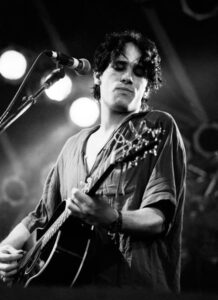
It’s Never Over, Jeff Buckley directed by Amy Berg, best known for her 2006 doc Deliver Us from Evil about sexual assault cases against the Catholic Church, is a beautifully constructed memory of the acclaimed singer and songwriter who died at the age of 30. Using performance footage, home videos, voicemail messages from the artist, and interviews with family, friends and fellow musicians including Aimee Mann, the director gives us a behind-the scenes look at the struggles Buckley faced living in the shadow of his father’s fame and death from an overdose at age 28, especially after the huge success of his 1994 album Grace. The collection of songs, including his cover of Leonard Cohen’s “Hallelujah” was lauded by musicians and critics alike around the world, instantly launching a frenzy of attention and, of course, pressure to follow up with something at lease equally as powerful, if not exceeding the hit album. Buckley’s voice was described as angelic, androgynous, and otherwordly, unlike any other contemporary singer. It was fascinating to learn about his early influences including Judy Garland, Diana Ross, Nina Simone, and Paul McCartney. He also loved Led Zeppelin, and you can hear echoes of Robert Plant’s vocal style in Buckley’s work. Paul and Linda McCartney loved his music and became friends with him, but even with their support, he still seemed lost between the trying to live down the legacy of his famous father and managing a difficult relationship with his mother, finding solace when he and his fiancé Joan Wasser from the Dambuilders moved to Memphis, Tennessee to work on his second album to be produced by Tom Verlaine. It was there that he finally felt free enough to explore his own identity and gender, where Wasser says he often wore her dresses at home. It was only weeks later that he drowned in the river near his house, the night before he and his band were set to begin recording. Although it was determined to be an accidental death, not a suicide or drug-related incident, the music world was left with a terrible void. We will never know how much more he could have achieved; like Hendrix, he showed the potential for true genius. It was, therefore, very sad and difficult to watch, but absolutely worth seeing. The film’s emotional rawness combined with the power of his music allows us to feel truly connected to the artist and spend a little more time with an extraordinary person. Not to be missed.
I stopped in at the Crown & Anchor for a beer before heading back to cottage. Vicki and I stayed up and talked for hours about her film career in New York, but we had to check out at 10 a.m. the next morning. We had breakfast at The Post Office Café and then I got the 11:30 ferry back to Boston.
The 2025 festival celebrated newcomers Eva Victor (Sorry, Baby) and River Gallo (Ponyboi), both Sundance alum, along with industry veterans Murray Bartlett (White Lotus) and Ari Aster whose forthcoming neo-Western Eddington starring Joaquin Phoenix and Paul Mescal premiered at Cannes and opens on July 18th. There were more parties this year and two industry panels, but I missed the one with Kimberly Pierce, director of Boys Don’t Cry, which I would like to have attended, because it conflicted with my first film on Thursday. It would be great if the panels were earlier as in years past so that one could attend a breakfast panel before the first screening of the day. But then it’s always a challenge to balance seeing films, attending parties, finding time to eat, hanging out with friends, and enjoying the beauty of Provincetown, especially when the weather is perfect. Very much looking forward to next year!